---
title: The future of patient-tracked data in clinical practice
description: How OB-GYNs use patient-tracked cycle, symptom, and wearable data, and what they want next, from Flo advisors Dr. Jennifer Boyle and Dr. Allison Rodgers
image: https://med.flo.health/hubfs/Biometric%20HCP%20article%20image.jpg
---
[ Flo is now **FSA/HSA** eligible](https://help.flo.health/hc/en-us/sections/31924129676564-Reimbursing-Flo-Premium-with-your-FSA-HSA-funds)
[Learn more](https://med.flo.health/blog/the-future-of-patient-tracked-data-in-clinical-practice#get-in-touch)
- [About Flo](https://med.flo.health/about-flo)
- [Perimenopause Support](https://med.flo.health/perimenopause-support)
- [Free Practice Resources](https://med.flo.health/co-care-pack)
- [Knowledge Hub](https://med.flo.health/)
- [Articles](https://med.flo.health/articles)
- [Medical Education](https://med.flo.health/cpd-obgyn)
- [Whitepapers](https://med.flo.health/whitepapers)
- [Blog](https://med.flo.health/blog)
- [Clinical Evidence](https://med.flo.health/)
- [Medical Accuracy](https://med.flo.health/medical-accuracy)
- [Science & Research](https://med.flo.health/science-and-research)
- [Data Privacy](https://med.flo.health/data-privacy)
[About Flo](https://med.flo.health/about-flo) [Perimenopause Support](https://med.flo.health/perimenopause-support) [Free Practice Resources](https://med.flo.health/co-care-pack)
[Knowledge Hub](https://med.flo.health/)
- [Articles](https://med.flo.health/articles)
- [Medical Education](https://med.flo.health/cpd-obgyn)
- [Whitepapers](https://med.flo.health/whitepapers)
- [Blog](https://med.flo.health/blog)
[Clinical Evidence](https://med.flo.health/)
- [Medical Accuracy](https://med.flo.health/medical-accuracy)
- [Science & Research](https://med.flo.health/science-and-research)
[Data Privacy](https://med.flo.health/data-privacy)
[Learn more](https://med.flo.health/blog/the-future-of-patient-tracked-data-in-clinical-practice#get-in-touch)
# The future of patient-tracked data in clinical practice
Published: 23 Sep 2026
For many OB-GYNs, cycle tracking is [already a cornerstone of clinical care](https://med.flo.health/articles/how-to-harness-patient-symptom-tracking-for-more-effective-care). As a [vital indicator](https://www.sciencedirect.com/science/article/abs/pii/S2666571924000380) of women’s health, menstrual cycle changes [can be useful](https://www.acog.org/-/media/project/acog/acogorg/clinical/files/committee-opinion/articles/2015/12/menstruation-in-girls-and-adolescents.pdf) in predicting potential health problems — and tracking tools provide clinicians with longitudinal data that can provide valuable context to support diagnosis and treatment. But as the digital health landscape continues to expand, patient-tracked data from wearable devices — like temperature, sleep, activity, and heart rate variability (HRV) — are beginning to offer an additional physiological layer.
In healthcare at large, [research points to](https://link.springer.com/article/10.1007/s10462-024-11009-5?utm_source=chatgpt.com) the promising potential of continuous, passively collected wearable signals in monitoring and observing health patterns across multiple conditions, from stress and depression to seizures and Parkinson’s disease. In reproductive health, early studies suggest wearable data may be helpful in [detecting ovulation timing](https://www.jmir.org/2019/4/e13404/?utm_source=chatgpt.com) and [monitoring changes during pregnancy](https://pubmed.ncbi.nlm.nih.gov/36904615/), offering a more continuous view of reproductive physiology outside the clinic.
So, as some digital health tools begin to integrate cycle and symptom tracking with wearable data like temperature, sleep, and activity, it raises important questions about how these enhanced data sets might support more personalized patient care. What does the trajectory look like for patient-tracked data in OB-GYN practice, and what do clinicians actually want from this kind of technology — today and in the future?
To explore these questions, we spoke with [Dr. Jennifer Boyle](https://flo.health/about-us/jennifer-boyle), obstetrician-gynecologist at Massachusetts General Hospital, and [Dr. Allison Rodgers](https://flo.health/about-us/allison-rodgers), reproductive endocrinologist and obstetrician-gynecologist at the Fertility Centers of Illinois — both of whom sit on Flo’s expert advisory board. This is what we learned.
# Straight-up cycle data remains the most clinically valuable
If there is one type of patient-tracked data OB-GYNs consistently rely on, it’s cycle history. Research shows that [self‑reported menstrual tracker data can uncover significant relationships](https://arxiv.org/abs/1909.11211?utm_source=chatgpt.com) between cycle length variability and symptoms, which can help clinicians in identifying and managing possible conditions. And the experts back this up.
“I strongly recommend that my patients track their menstrual cycles — not just their bleeding days, but any symptoms that are bothering them,” says Dr. Boyle. “People, meaning both doctors and patients, often underestimate how crucially important this data can be in making a diagnoses and in finding a solution.”
For example, “how we approach and treat abnormal uterine bleeding depends on the specifics of a patient’s bleeding history,” she elaborates. “Trying to determine if a patient has an underlying mood disorder, such as anxiety or depression, versus premenstrual dysphoria disorder depends entirely on knowing when the symptoms occur with relation to the menstrual cycle.”
Dr. Rodgers echoes similar sentiments from a fertility perspective, noting the value of details like period dates and symptom logs (most notably spotting, discharge and breast tenderness) in determining “if there is an ovulatory component to a patient’s infertility, and if they’re at risk for causes such as endometriosis or PMOS.”
In addition, both Dr. Boyle and Dr. Rodgers note the benefits of [cycle-tracking tools’ enhancement of patient health literacy](https://mhealth.jmir.org/2024/1/e54124/?utm_source=chatgpt.com): when patients have a better understanding of what’s going on with their bodies, it can fast track communication during consultations — and by extension, it can fast track care.
For more practical insights on how to harness patient-tracked cycle data in clinical practice, [read Flo’s guide for OB-GYNs](https://med.flo.health/articles/how-to-harness-patient-symptom-tracking-for-more-effective-care).
# Wearable data can add context — but it’s not always necessary
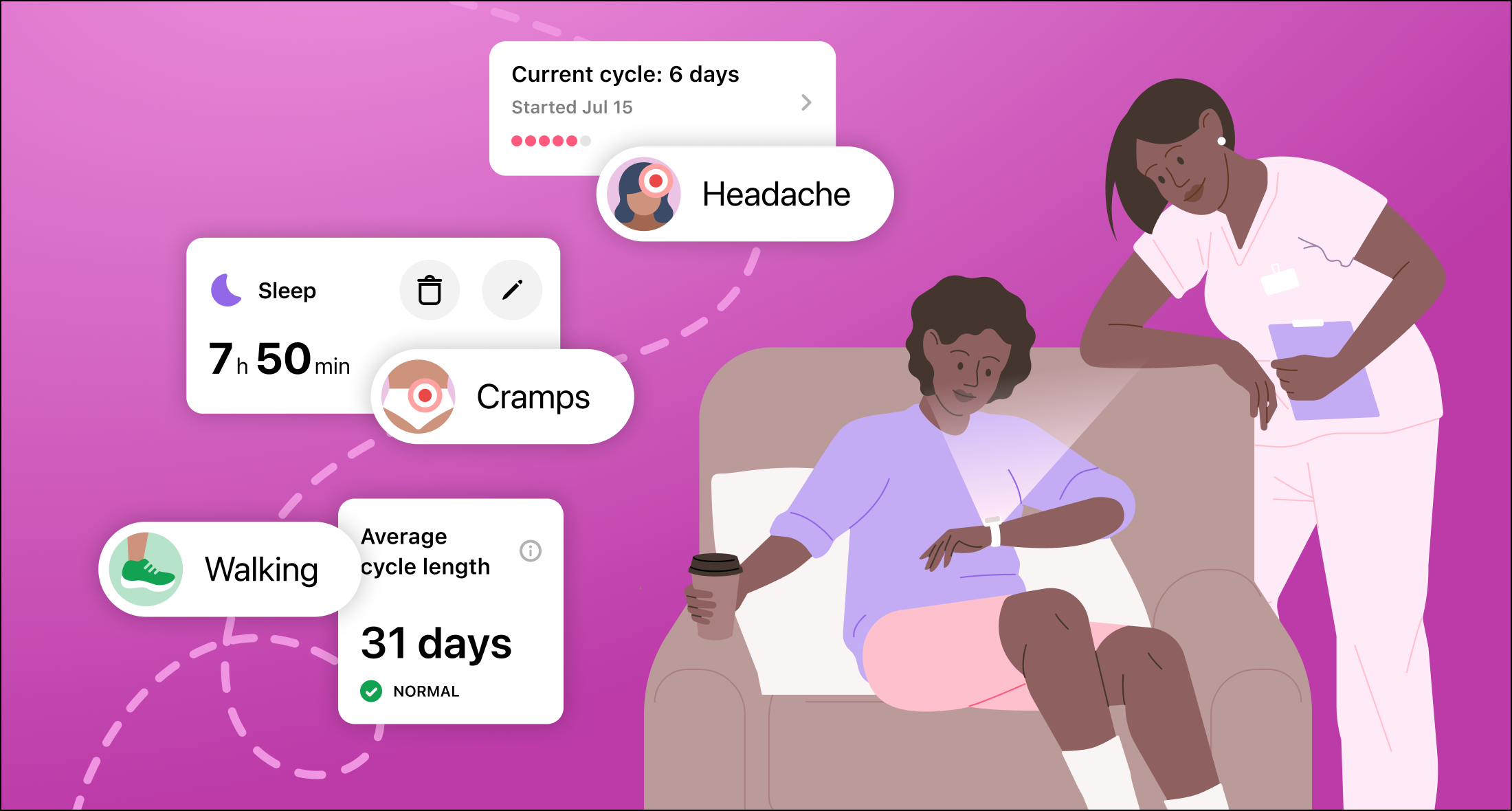
Wearables and other tracking tools offer new ways for patients to capture continuous physiologic data, from temperature and sleep to activity and heart rate variability (HRV).
[Research shows](https://www.jmir.org/2019/4/e13404/?utm_source=chatgpt.com) that wearable data such as skin temperature, HRV, and resting heart rate can detect cycle phase changes and help estimate potential fertile windows , and some studies show temperature-based wearables can detect ovulation without daily manual BBT measurement. This kind of data is sometimes incorporated for personalized fertility evaluation, Dr. Rodgers says, helping guide treatment.
[Other research shows](https://pubmed.ncbi.nlm.nih.gov/36904615/?utm_source=chatgpt.com) that wearable data can help effectively monitor maternal and fetal health during pregnancy. Dr. Boyle notes that she may ask pregnant patients to track health metrics such as heart rate or blood pressure in certain contexts, e.g. to help monitor “glucose values for patients with gestational diabetes and blood pressure values for people with hypertension.”
On the whole, sleep or physical activity data may also give clinicians context for symptoms raised in consultations, be it brain fog, fatigue, or mood changes.
But Dr. Boyle counters with an important point: More data is not always better data. “Sometimes patients show me BBT or health ring data, and it’s not as useful as you might think,” she says — since oftentimes, symptom logs and bleeding history are sufficient data on their own. Dr. Rodgers, too, emphasizes the importance of asking specific questions about specific data points in order to streamline — rather than slow down — care.
Ultimately, “the goal should be for patients to get to know their bodies,” Dr. Boyle concludes. If technology can meaningfully support that, it’s a win. But she cautions against technology for technology’s sake — particularly if it can weaken patients’ body awareness by encouraging over reliance on numbers on a screen, instead of their own felt signals.
# The future of patient-tracked data is smarter synthesis — not just more signals
There is [growing research interest](https://pmc.ncbi.nlm.nih.gov/articles/PMC10585447/) in multi-signal health modeling, combining physiologic metrics, behavior data, and symptom tracking to understand health trajectories more holistically.
Looking ahead, it seems the most useful shift for OB-GYNs won’t be in patients collecting every possible health metric, but in being able to integrate the right signals into something clinically meaningful. Flo can already integrate with compatible wearable devices, while helping patients capture longitudinal patterns in their cycles and symptoms, such as changes in cycle length, missed periods, or recurring symptoms, giving additional context to consider alongside the clinical history, examination, and appropriate investigations.
Dr. Rodgers sees plenty of potential on the technological horizon — “for patients who are trying to conceive, yes, but also those trying to avoid pregnancy, manage hormones and abnormalities (such as PMOS), and navigate erratic cycles from perimenopause.” Especially with the additional possibilities of AI integration, she adds, helping to translate complex data into meaningful insights for users.
But both experts stress that technology should support, not replace, patients’ body literacy — and the human component of patient care must remain front and centre. “I think we have to stay aware of our natural human attraction to all things that seem technological,” Dr. Boyle says.
“Simply seeing a log of a patient’s biometrics is not what I want to focus on as a doctor. I want to have more of a conversation about what matters most to people, how they feel about their condition, what their goals are, and what barriers exist that could prevent them from reaching their goals.”
Indeed, at their best, digital tools don’t, and should never, replace patients’ attunement to their bodies, or relationships with their care providers. But the right ones can augment the interplay to be more informed, more efficient, and more personalized.
Flo is designed for cycle tracking and health education; it is not intended as a method of contraception or a tool to diagnose or manage medical conditions.

##### Stay up to date
You’re busy, we get it. Sign up to get the latest research and evidence in women’s health, plus practical tools and resources to help you save time and support your patients.
###### Product
- [Tracking cycle](https://flo.health/product-tour/tracking-cycle)
- [Getting pregnant](https://flo.health/product-tour/getting-pregnant)
- [Pregnancy](https://flo.health/product-tour/pregnancy)
- [Help Centre](https://help.flo.health/hc/en-us)
- [Privacy Portal](https://flo.health/privacy-portal)
###### Company
- [About us](https://flo.health/about-flo)
- [Medical affairs](https://flo.health/medical-expertise)
- [Science & Research](https://flo.health/science-and-research)
- [Careers](https://flo.health/careers)
- [Contact](https://flo.health/contact-us)
- [Press Center](https://flo.health/press-center)
###### Privacy
- [Privacy policy](https://flo.health/privacy-policy)
- [Terms of use](https://flo.health/terms-of-service)
- [Cookie policy](https://flo.health/cookie-policy)
- [Trademark Usage](https://flo.health/trademark-usage-guidelines)
- Your Privacy Choices
###### SOCIAL MEDIA
- [Instagram](https://www.instagram.com/flotracker/)
- [Facebook](https://www.facebook.com/flotracker/)
- [TikTok](https://www.tiktok.com/@flotracker?lang=en)
- [Linkedin](https://www.linkedin.com/company/flo-by-flohealth-inc/)
###### Flo App
The #1 period and ovulation tracker worldwide
© 2026 Flo Health Inc., Flo Health UK Limited
```json
{
"@context" : "https://schema.org",
"@type" : "BlogPosting",
"author" : {
"@type" : "Person",
"name" : "Flo Health",
"url" : "https://med.flo.health/blog/author/flo-health"
},
"dateModified" : "2026-09-24T11:01:29.126Z",
"datePublished" : "2026-09-23T12:16:55.000Z",
"headline" : "The future of patient-tracked data in clinical practice",
"image" : [ "https://med.flo.health/hubfs/Biometric%20HCP%20article%20image.jpg" ],
"mainEntityOfPage" : {
"@id" : "https://med.flo.health/blog/the-future-of-patient-tracked-data-in-clinical-practice",
"@type" : "WebPage"
},
"publisher" : {
"@type" : "Organization",
"logo" : {
"@type" : "ImageObject",
"url" : "https://med.flo.health/hubfs/Flo-Logo.png"
}
}
}
```